Jan 26 2010

Lunch break: spam musubi

kathi

I grew up in Hawaii. Spam is a legitimate food item. Don’t go ewww’ing at me. Hey, it’s not like you never eat things I wouldn’t put on my table, let alone in my mouth, so don’t judge me.
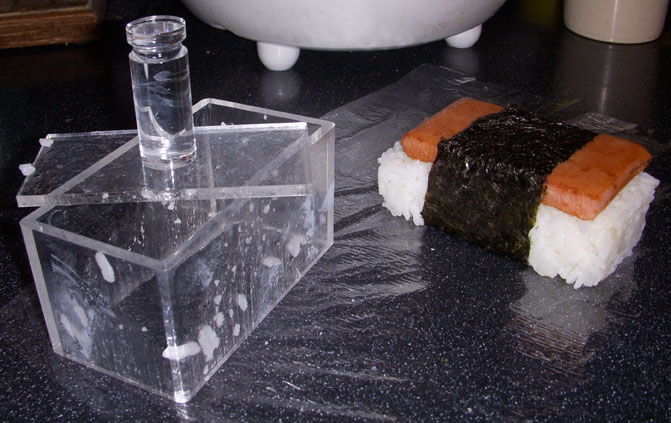
You might notice something contradictory in this photo of my lunch just before I wrapped it. I’ve mentioned before that you don’t really need a musubi press to make these. Well, you don’t, and I still wouldn’t buy an overpriced one online. Picking one up at the drugstore in Honolulu for a reasonable price is another matter indeed. As you can see, I did use it this morning. It made things go slightly faster so maybe I will come over to the dark side on this.

I have to say I am amazed at the number of spam musubi how-to pages that exist online, including those with photo or video step-by-steps. Some of them make it sound so complicated that you’d think it takes longer to make than a gourmet meal. But all you really need to say is what Chris Pirillo said.

What? Despite all that, you still want to know how I make mine? I’ll try not to make it sound too complicated:

Rice. I personally don’t care if it’s hot, warm or cold. Maybe you do, and that’s fine. It has to be short-grain calrose rice, cooked so it sticks together. See the overpriced Zojirushi rice cooker in the background? Absolutely the best way to go. Some things are worth their overly high prices.

Spam. This morning I used one of those single serving packages. I usually fry it in soy sauce with a dash of sugar, but I was short on time so I just nuked it with same for half a minute on each side. The single serving slice yields two pieces that fit the musubi mold, and there is a little strip left over for the dogs. Dogs love spam or hot dogs cooked in soy sauce. Trust me on this. I guess you could eat the little strip yourself if you don’t have a dog to help.

Sushi nori. I like mine to cover about one-third to one-half of the musubi, not the whole thing. So that is the width of the strip I tear off.

Put sushi nori on a plate, or if you are packing a lunch, a piece of plastic wrap. Put the musubi mold on top of the nori, towards one end of the strip. Put some rice in and pack it down tight. Lift off the mold, put the spam on top of the rice, and wrap the nori around. Enjoy, or wrap and pack.

You say I am doing that wrong? No, I am just not making it the way you like best. Go make your own!

I am a long-time satisfied user of Hormel’s Spam and Zojirushi’s rice cookers, and I have no connection to either company. Rice cooker and Spam were purchased by my husband and me.

(NaBloPoMo | January ’10: 26 of 31)


Jan 11 2010

Snack break: teriyaki meatballs

kathi

I think I’ve mentioned a couple of “retro-local” cookbooks with favorite tastes from my childhood in Hawaii that I always keep nearby. This is one of them:

This was a fundraiser cookbook produced by the women of Hui Manaolana, a service club which my aunt belonged to since she was a student at the University of Hawaii. She is 99 years old now, and the first edition of this cookbook was published in 1951. My own copy is from the 1969 printing. The recipes are those of the club members and their families and friends, very typical Hawaii Japanese home cooking.

I have made the teriyaki meatballs from this cookbook as appetizers for family gatherings and parties. They are quite well-liked, and I never seem to get to eat any of them myself before they are all snarfed down by others. My fault for not putting a couple aside for myself when I make them!

The last time I made them was for a party in December that I was not attending as a persistent winter cold had sapped all my energy and sociability. I went so far as to get out a small container to put my meatballs aside… then forgot to actually put any meatballs in it. By the time I realized my error, the meatballs were several miles down the road on the way to the party. Oh, well!

Following is the recipe, with my own changes noted. You can substitute dried powdered ginger and garlic if you absolutely have to, but using fresh ginger root and garlic, especially in the sauce, will make a very positive difference.

Teriyaki Meatballs
(from Hui Manaolana’s Japanese Foods cookbook)

Meatballs:
1½ pounds lean ground beef
¼ cup finely chopped onion
1 egg
½ teaspoon salt
dash of black pepper
2 tablespoons shoyu (soy sauce – imported Japanese soy sauce, please, or if you use domestic soy sauce, please use Kikkoman)
½ teaspoon grated ginger
1 clove garlic, grated
1 teaspoon brown sugar
Mix thoroughly and form into appetizer-sized meatballs. Bake at 350° for 8 minutes on each side.

Sauce:
1 cup shoyu (see above)
2 tablespoons sake (Japanese rice wine – if I don’t have any, I just leave it out rather than substitute any other type of spirits and add a little more shoyu)
6 tablespoons sugar (since I have the brown sugar out for the meatballs, I usually do 3 tablespoons brown sugar and 3 tablespoons white sugar)
2 teaspoons grated ginger
2 cloves garlic, grated
1½ teaspoons cornstarch mixed with cold water
Bring all ingredients except cornstarch mixture to a boil. Add cornstarch mixture slowly and stir until sauce thickens slightly. Pour over meatballs and enjoy. (EDITED TO ADD: the last time I made this, my grater went missing, so I strained out the not-quite-fine enough fragments of ginger and garlic before adding the cornstarch mixture)

(NaBloPoMo | January ’10: 11 of 31)


Oct 12 2009

Ghosts of cookbooks past

kathi

I recently received two new cookbooks as a gift from their co-author. I had to stop and think how long it had been since I’d bought or requested a new cookbook. More about those two books in an upcoming post; there are some very tasty-sounding recipes that I am definitely going to try.

You know that I often go back to my ’70s vintage Hongwanji cookbooks for tastes from my growing-up years in Hawaii. I am not much of a cook, and the thought of cooking anything from The Art of French Cooking, let alone working through the whole book, would fill me with fear. But I was talking with someone about that whole Julie and Julia thing, and mentioned the French cookbooks that not only didn’t scare me off, but that I’ve actually used again and again over the years. The stained pages, handwritten notes and covers starting to tear a little all attest to that.

Those would be Pierre Franey’s The New York Times 60-Minute Gourmet and New York Times More 60 Minute Gourmet. Check out the oh-so-’70s typography and layout on the original paperback cover! I guess we are much more impatient these days, and we must now have our “30-Minute Meals.” But an hour for dinner prep seemed pretty reasonable back then. The recipes are quite heavy on cream and butter by 21st century standards, but you can either substitute or remember that no one lives forever, and who wants to live without real butter anyway. The recipes are easy enough for just about anyone to make, and mostly within those 60 minutes as well. And they are so tasty.

I think it’s time to drag those out again. I am getting hungry just thinking of the steak with peppercorns from one of these books!

(NaBloPoMo | October ’09: 12 of 31 | 75% Challenge: 234 of 274)


Jun 30 2009

Li hing mui margarita lost in the vast midwestern wasteland

kathi

I’ve never seen a li hing mui margarita in the wild anywhere in the vast midwestern wasteland. And we do have a few bars or restaurants here where you’d think they might be hiding.

I don’t think they are as popular as they used to be in Hawaii either. On our last trip to Honolulu in February, I was horrified to find out that the Royal Hawaiian Hotel’s beachside Mai Tai Bar no longer serves them. How can the famous pink hotel cut a pink drink from its menu? That is just plain wrong.

Oh. Li hing mui is Chinese preserved dried plum. It’s sweet, sour and salty.

There are still a lot of recipes for li hing mui margaritas available online, and I did think far enough ahead to buy some li hing mui powder on one of our Honolulu trips. It took a while to go through the recipes as I was simply not interested in anything frozen with extra fruit.

My days of tequila shots are far in the past, and even the “correct” margarita mix that is 50% tequila just doesn’t work for me these days because it makes it too easy for the Rottweilers to knock me over. Although it might be a surprise to anyone who knew me back when, I picked a recipe that ended up being only 20% tequila: Homemade Li Hing Margarita from House of Annie.

I did make my own sweet and sour mix, too, but with Rose’s Lime Juice and ReaLemon instead of fresh squeezed juices. My tequila was Jose Cuervo Silver (my favorite is actually Herradura Silver) and my orange liqueur was Cointreau.

So my drink ended up being:

2 oz. sweet and sour mix
1 oz. Jose Cuervo Silver tequila
1 oz. Cointreau orange liqueur
1 oz. Rose’s Lime Juice
1/4 tsp. li hing mui powder (this goes in the drink; what goes on the rim is extra)

I like to mix some kosher salt with li hing mui powder for the rim of the glass. I know not everyone agrees with that, but it was my drink.

And it was really good!

(NaBloPoMo | June ’09: 30 of 30 | 75% Challenge: 157 of 274)


Jun 24 2009

Taste from my past: Khal bi marinade

kathi

In addition to not being the history expert of the family, I am also not the main cook. That, again, would be my husband. He has been experimenting with a number of different tastes for the outdoor cooking season. The one that comes straight from my younger days in Honolulu is khal bi, or Korean style barbequed short ribs.

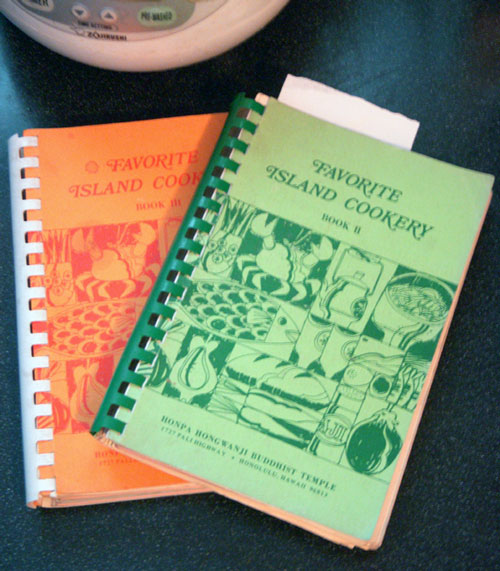
Two volumes of the Hongwanji cookbooks have stayed with me throughout my entire adult life. There are six volumes in total, featuring recipes from the members of the Honpa Hongwanji Buddhist Temple. I guess you could call it retro food, Hawaii style. The first one was published in 1973 as a fundraiser, and the entire cookbook series remains a popular and successful fundraising item for the temple.

cookbooks_0111

That is my overpriced Zojirushi Neuro Fuzzy rice cooker behind the cookbooks!

This marinade is not just for short ribs. Tested and checked out as good are rib eye steaks, chicken breasts, and thin sliced round steak. We made a few changes to the recipe in the book, and following is our version:

1 cup soy sauce
2 tablespoons brown sugar
4 cloves garlic, finely chopped
1 small piece ginger root, grated
3-4 stalks green onion, chopped
2 teaspoons sesame oil
black pepper
chili oil OR crushed red pepper flakes (Not both! Well, unless you really like it hot. Amount depends on how hot you like it. Start small. Well, again, unless you really like it hot.)

Mix all ingredients well. Marinate your meat of choice for an hour or longer (overnight is best). Grill or broil. Eat. Enjoy!

(NaBloPoMo | June ’09: 24 of 30 | 75% Challenge: 151 of 274)


Jun 15 2009

Something to do with leftovers

kathi

Something for people: Fried Rice

I am of Japanese ancestry, so there is always rice here. I used to make fried rice from leftovers quite often, especially during my younger and leaner years. The ingredients change depending upon what leftovers are available. The only constants are rice, egg, and soy sauce. The rice absolutely has to be leftover cold rice. If you are making a new pot of rice just for frying, sorry. You are not having fried rice until tomorrow! Freshly cooked rice is too moist and sticky to fry.

I had a taste for fried rice the other day. There were some shredded carrots left over from a pasta salad, some green onion stalks left over from Korean short ribs made earlier in the week, and some of those Korean short ribs. Perfect. The shredded carrots were a bit longer than I prefer, so I took a large handful and chopped them up a little more. I chopped up one green onion stalk, using both green and white portions. Then I chopped up the short rib meat. I didn’t use very much meat, maybe 1/4-1/3 cup. This all went into a frying pan to cook until the carrots and onions were soft and everything was hot. Short rib meat has enough grease, but if I’d used a leaner meat, I would have added a tiny bit of oil to the pan. Then the rice went in (I had about 2 cups) and everything stirred around until the rice was warm and the meat and vegetables were distributed evenly throughout. One raw beaten egg and some soy sauce to taste went in next, and stirred and tossed until the egg was cooked. If I had oyster sauce, I would have used some of that instead.

Yum :)

Something for dogs: Training Treats

The short ribs were a little too greasy to use for this, but any leaner leftover beef will work just fine. Cut it into small dice, spread them out on a paper plate, cover with waxed paper and microwave for 1-2 minutes, until they are somewhat dried out. Allow to cool completely before storing. They will last a few days in the refrigerator and a very long time in the freezer. I put just enough for a training class into each zip-lock baggie so I can just grab a baggie out of the freezer before heading to class. The treats thaw out on the way, and my dogs seem to consider them a high-value reward.

(NaBloPoMo | June ‘09: 15 of 30 | 75% Challenge: 142 of 274)


Mar 6 2009

Another thing I’m not giving up (6 of 31/41 of 274)

kathi

My religious customs and beliefs do not require me to give up meat, even temporarily. I feel that my God is good that way, because I am quite the carnivore. I verified this fact about myself during my first attempt at college, when peer pressure encouraged me to try switching to a vegetarian diet. I stuck it out for about a month, but the call of the hog was too much to bear. I don’t want to live forever if the possibility of bacon is forever off the table.

Still, I often forego meat on Fridays during Lent. I hope my husband and co-workers think I do this out of consideration. I doubt they are fooled, though. They know that deep down, all right, fine, not so deep down at all, I would think that parading a BBQ pork sandwich through a room of denied meat lovers is just the biggest fun ever.

So no, not consideration at all. It is just my love for pepper and egg sandwiches, which are found everywhere in Chicago during Lent. Is it a little weird that we went to Mr. Beef for our pepper and egg sandwiches today though?